
Eyebrow Pencil Sample Too Soft or Too Hard? How to Find the Right Formula Balance
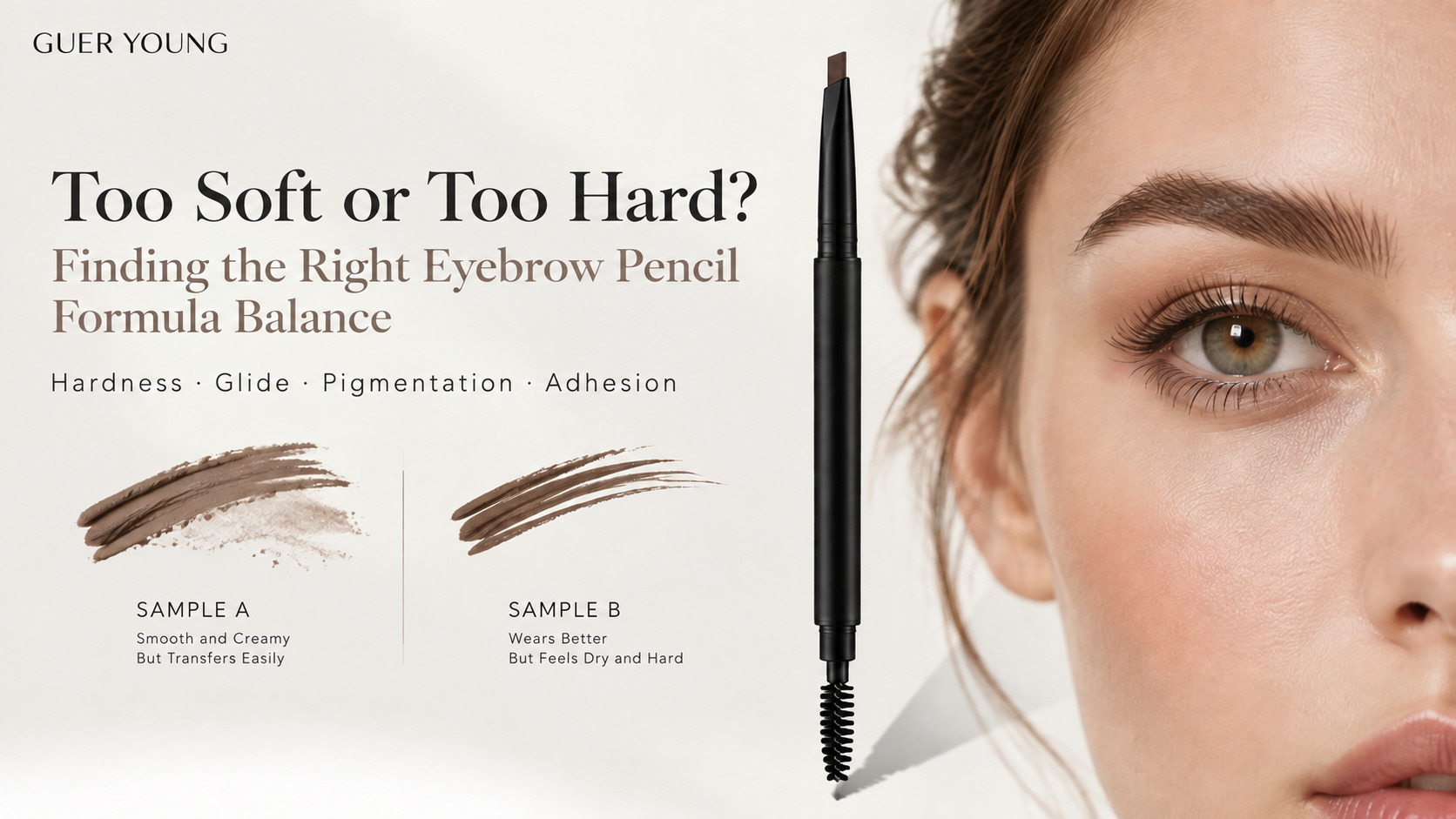
Sample A is smooth and creamy, but transfers too easily. Sample B wears better, but feels dry and hard. Which direction should you choose?
If you're developing a custom eyebrow pencil, this is a common sampling problem.
A brand may like the smooth application of one formula but prefer the stability of another. The natural reaction is often:
“Can we make Sample B smoother?”
Or:
“Can we keep the creamy feel of Sample A but make it wear better?”
The answer usually isn't to simply make one sample softer or harder.
A successful eyebrow pencil formula needs to balance four connected properties:
Hardness + Glide + Pigmentation + Adhesion
The real development question is:
What balance creates the application, brow look, and wear performance your brand actually wants?

Why “Make the Eyebrow Pencil Smoother” Isn't Specific Enough
Smoothness is one of the first things brands notice when comparing eyebrow pencil samples.
A smooth eyebrow pencil moves easily across the brow area, releases color without excessive pressure, and feels comfortable during application.
But when a brand says:
“We want it smoother.”
What exactly needs to change?
Does the sample:
drag against the skin?
require too much pressure?
release too little color?
feel too hard?
lack a creamy sensation?
need too many strokes to build color?
These problems may feel similar during application, but they do not necessarily require the same formula adjustment.
Glide comes from the interaction between oils, emollients, waxes, powders, pigments, and other structuring components.
Changing that balance can also affect hardness, pigmentation, line precision, adhesion, and product stability.
So instead of asking only:
“Can you make it smoother?”
give your development team a more specific target:
“The first stroke feels too dry and requires too much pressure. We want easier color release while keeping enough firmness for precise definition.”
That feedback is much more useful.
Why Can a Smooth Eyebrow Pencil Transfer More Easily?
A highly creamy eyebrow pencil can create an excellent first impression.
It glides easily, releases color quickly, and often looks impressive in an initial arm swatch.
But a good swatch doesn't tell you everything.
Once the color has been deposited, it also needs to remain sufficiently stable on the skin.
Push a formula too far toward softness and slip, and you may see:
excellent glide but weaker line control;
strong color payoff but more transfer;
a creamy feel but less brow-tail precision;
an attractive swatch but disappointing wear.
This is why:
Smooth application ≠ better overall performance.
For products with stronger wear claims, water resistance is also only one part of the performance picture. Sweat, sebum, friction, and extended wear may need separate evaluation. For a broader breakdown, see our guide to [waterproof and long-wear eyebrow pencil development].
For the formula itself, however, the immediate challenge is simpler:
How do you improve application without making the pencil too soft, too pigmented, or too easy to transfer?
The 4 Factors to Compare in an Eyebrow Pencil Formula
When a sample is “almost right,” don't evaluate it only as good or bad.
Break the experience into four areas.

1. Hardness: Is the Pencil Too Hard or Too Soft?
If the pencil is too hard, you may notice:
dry application;
dragging against the skin;
weak first-stroke color;
repeated strokes required to build the brow.
But going too soft creates a different set of problems:
thicker, less controlled lines;
reduced precision;
faster product consumption;
more transfer;
possible core stability issues.
The ideal hardness depends on the desired brow effect.
A pencil for fine, hair-like definition may require more firmness than one designed for quick, soft filling.
2. Glide: Is It Smooth but Still Controlled?
Glide determines how easily the pencil travels across the brow.
Too little glide creates drag.
Too much can make the formula feel overly creamy and reduce control.
For many eyebrow pencil projects, the target is not:
“As smooth as possible.”
It is:
“Smooth enough to apply comfortably, but controlled enough to define.”
3. Pigmentation: How Much Color Should One Stroke Deliver?
More pigmentation isn't always better.
A natural everyday brow pencil may need softer, buildable color so consumers can gradually create definition.
A stronger definition product may need more immediate payoff.
This means brands should evaluate pigmentation together with glide.
A very soft, creamy pencil with high first-stroke pigmentation may release more color than the target consumer actually wants.
Ask:
“Does one normal stroke deliver the right amount of color for our intended brow look?”
4. Adhesion: What Happens After Application?
This is where many smooth samples reveal their weakness.
The formula needs to transfer from the pencil to the skin easily—but once deposited, the color also needs enough stability to remain where it was placed.
The target is:
Easy enough to deposit. Stable enough to stay.
That is why Glide and Adhesion should not be evaluated separately.
Case Study: Sample A Was Smooth, but Sample B Wore Better
We encountered this exact problem during a custom eyebrow pencil development project.
The client's target sounded straightforward:
Smooth application. Natural color payoff. Good line control. Reliable wear.
But the first samples moved in two different directions.
Sample A: Smooth and Creamy, but Too Easy to Transfer
Sample A immediately felt appealing.
It glided easily, released color quickly, and delivered the creamy sensation the client had requested.
The initial swatch looked excellent.
But after application, the weakness became clearer: the color transferred too easily and did not provide the stability the brand wanted.
In short:
Great application. Not enough post-application stability.
Sample B: Better Stability, but Too Dry and Hard
Sample B improved stability.
But application became noticeably less comfortable.
The pencil felt firmer and drier, and the user needed more pressure and repeated strokes to achieve the desired color.
The brand was now choosing between two extremes:
Sample A → smoother application, weaker stability
Sample B → better stability, harder application
The client asked:
“Can we keep the smoothness of Sample A and the stability of Sample B?”
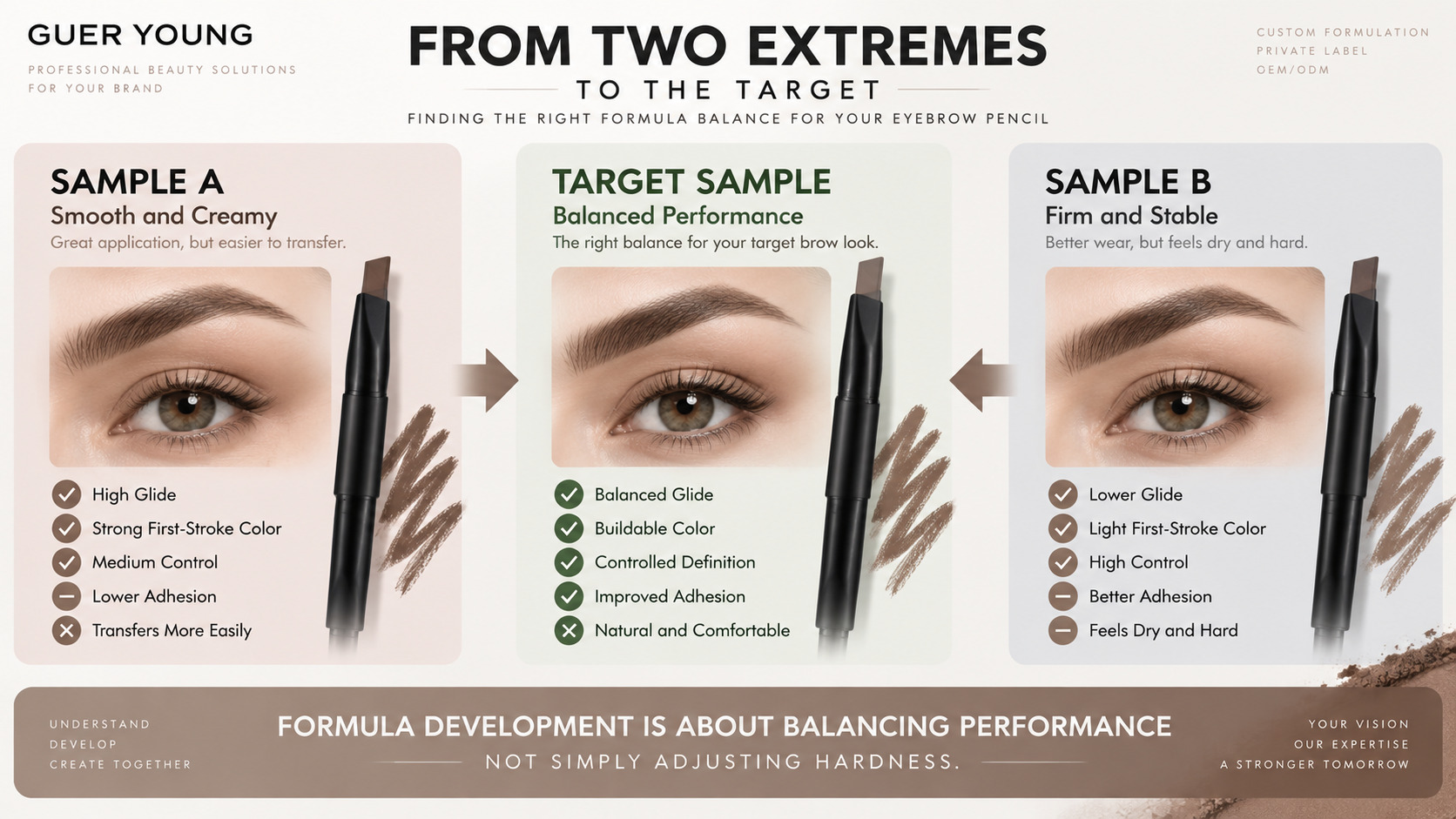
Why We Didn't Simply Make Sample B Softer
When GUER YOUNG reviewed the samples, simply reducing Sample B's hardness was not the goal.
Making it softer without considering the rest of the formula could move the product back toward the same problems found in Sample A.
Instead, we clarified what the brand actually wanted the consumer to experience.
The target became:
comfortable glide without excessive softness;
natural first-stroke pigmentation;
buildable color rather than overly strong payoff;
enough firmness for controlled definition;
better stability after application.
The development question therefore changed from:
“How do we make Sample B softer?”
to:
“What balance of Hardness, Glide, Pigmentation, and Adhesion creates the experience this product needs?”
That distinction matters.
The objective wasn't to maximize smoothness.
It was to find the right balance.
How Should Brands Compare the Next Sample Round?
Instead of evaluating samples only by first impression, compare each version using the same criteria.
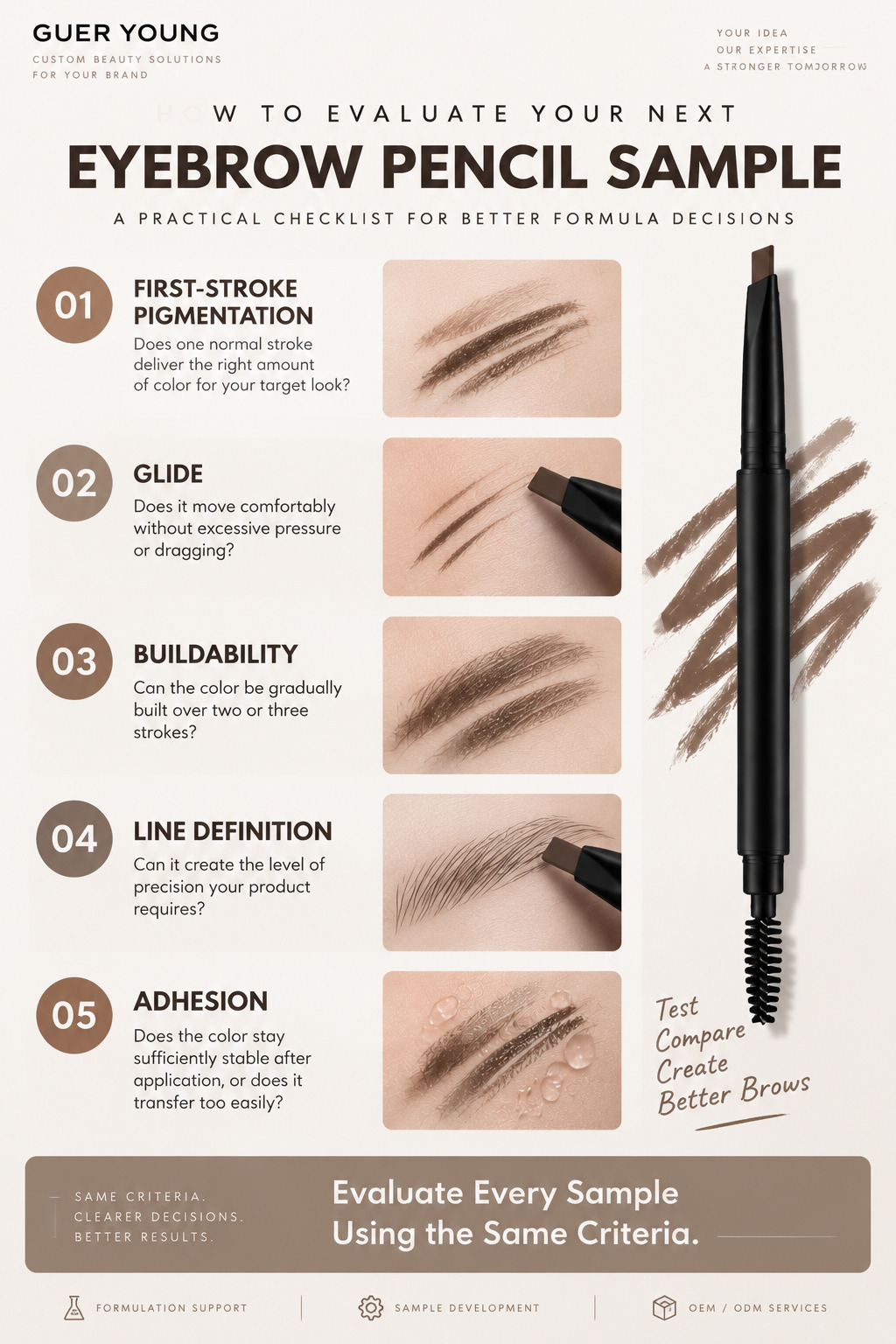
First-Stroke Pigmentation
How much color appears with one normal stroke?
Is it too light, too strong, or appropriate for the intended look?
Glide
Does the pencil move comfortably without excessive pressure?
Does greater glide reduce control?
Buildability
Can the consumer gradually build color over two or three strokes?
Line Definition
Can the pencil create the level of precision the product positioning requires?
Adhesion
After application, does the color remain sufficiently stable or transfer too easily?
A simple comparison might look like this:
| Sample | Glide | First-Stroke Color | Line Control | Adhesion |
Sample A | High | Strong | Medium | Lower |
Sample B | Lower | Light | High | Better |
Target Sample | Balanced | Buildable | Controlled | Improved |
This gives the formulation team much more useful information than:
“We like Sample A better.”
Give Your Eyebrow Pencil Manufacturer Better Sample Feedback
One of the easiest ways to improve the sampling process is to make feedback more specific.
Instead of:
“Too hard.”
Try:
“The first stroke requires too much pressure and doesn't deposit enough color.”
Instead of:
“Not smooth enough.”
Try:
“There is noticeable drag when defining the brow tail.”
Instead of:
“Too pigmented.”
Try:
“One stroke deposits too much color for the natural, buildable effect we want.”
Instead of:
“It doesn't last.”
Try:
“Application feels good, but the color transfers too easily afterward.”
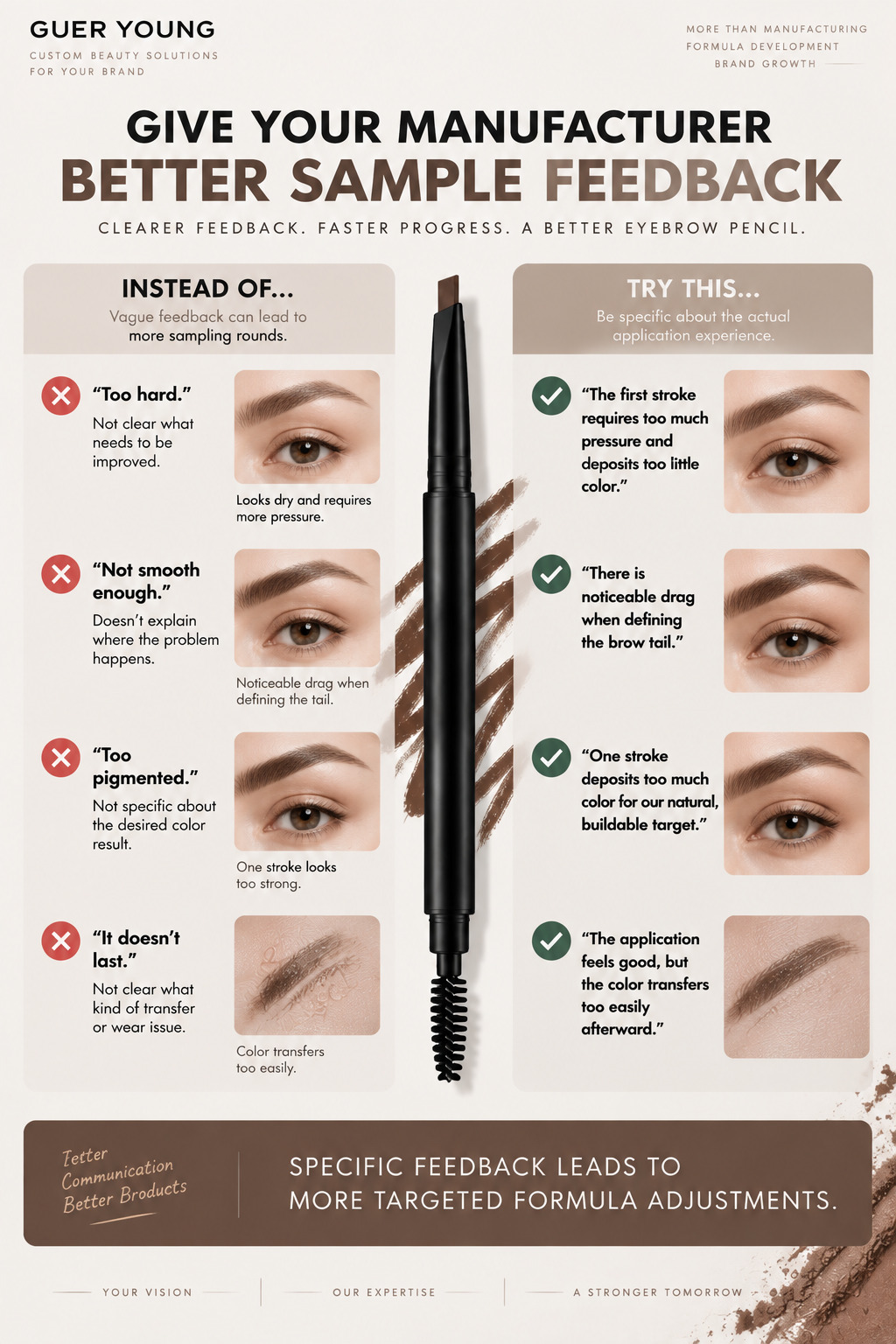
Specific feedback helps your eyebrow pencil manufacturer understand which performance parameter needs attention.
It can also help reduce unnecessary rounds of sampling.
Benchmarking a Competitor? Explain What You Actually Like
Brands often send a competitor sample and say:
“Make ours like this.”
But a benchmark alone doesn't explain what the brand wants to reproduce.
Do you like its:
hardness?
glide?
first-stroke pigmentation?
creamy feel?
buildability?
line precision?
post-application stability?
Two eyebrow pencils can feel similarly smooth while behaving very differently.
When benchmarking, compare:
Hardness → Glide → First-Stroke Pigmentation → Buildability → Line Definition → Adhesion
Then tell your development team which characteristics you want to keep and which ones you want to improve.
The goal isn't necessarily to copy the benchmark.
The goal is to understand why it works for your target product.
Different Brow Products Need Different Formula Balance
There is no single ideal eyebrow pencil formula.
The right balance depends on positioning.
Hair-Like Definition
A pencil designed for precise strokes may need:
more firmness + controlled glide + buildable pigmentation
Natural Everyday Filling
A daily brow pencil may prioritize:
comfortable glide + natural payoff + easy buildability
Creamy Brow Pencil
A product positioned around creaminess may emphasize:
more noticeable glide + faster color release
But the brand still needs to decide how much precision and post-application stability it expects.
Stronger Wear Positioning
A product focused on wear may place greater emphasis on adhesion and stability while still maintaining comfortable application.
The formula should follow the intended consumer experience—not a universal idea of what the “best” eyebrow pencil should feel like.
Before Requesting Your Next Custom Eyebrow Pencil Sample
Before asking for another custom eyebrow pencil sample, define these five things:
1. What is wrong with the current sample?
Hardness, drag, excessive softness, pigmentation, line control, transfer—or something else?
2. What should one stroke look like?
Light and buildable or immediately visible?
3. How should the pencil feel?
Firm and precise, balanced, or noticeably creamy?
4. What brow effect are you targeting?
Hair-like definition, natural filling, soft diffused brows, or stronger definition?
5. What exactly do you like about your benchmark?
Don't just send the product. Explain which parts of its performance you want to reproduce or improve.
The clearer these answers are, the easier it becomes to determine whether an existing formula fits—or whether further customization is needed.
Your Eyebrow Pencil Doesn't Need to Be as Smooth as Possible
If Sample A is smooth but transfers too easily, making every future sample equally creamy may not solve the problem.
If Sample B wears better but feels too hard, simply making it softer may create another trade-off.
The real target is the relationship between:
Hardness + Glide + Pigmentation + Adhesion
GUER YOUNG supports eyebrow pencil development based on target product experience, benchmark samples, desired brow effects, and actual sample feedback. Instead of treating smoothness as an isolated requirement, development can focus on finding the balance that fits your product positioning.
If your current samples are stuck between:
“Smooth but transfers too easily”
and
“More stable but too dry and hard,”
send us your benchmark, current sample feedback, and the brow experience you want to create.
The next sample shouldn't simply be softer or harder. It should be closer to your target.


andy.li@gueryoung.com

We have 10 years of experience, focusing on the development and sales of high quality eyelash growth serum, mascara, eyebrow gel, eyebrow color and other products. We also offer custom services, from tube
design to cosmetic fillings and packaging


Room 1, C3 Factory Building, No.8803 Zhuhai Avenue, Lianwan Industrial Zone, Pingsha Town, Gaolan Port Economic Zone, Zhuhai, Guangdong,China
QUICK LINKS
D Zone,5/F, NO.8 CuiZhu 5th Street,
Qianshan Xiangzhou District,Zhuhai,
Guangdong,China,519070

lynn.zhou@gueryoung.com
winnie.zhong@gueryoung.com
niki.xu@gueryoung.com