
Product
Article
NameDescriptionContent

NameDescriptionContent
Why the Same Liquid Eyeliner Pen Can Deliver 18–25% Higher Gross Margin in Russia — Many Brands Get Pricing Wrong from Day One
Source:
|
作者:selina
|
Release time:2025-12-25
|
55 Second visit:
|
Share:
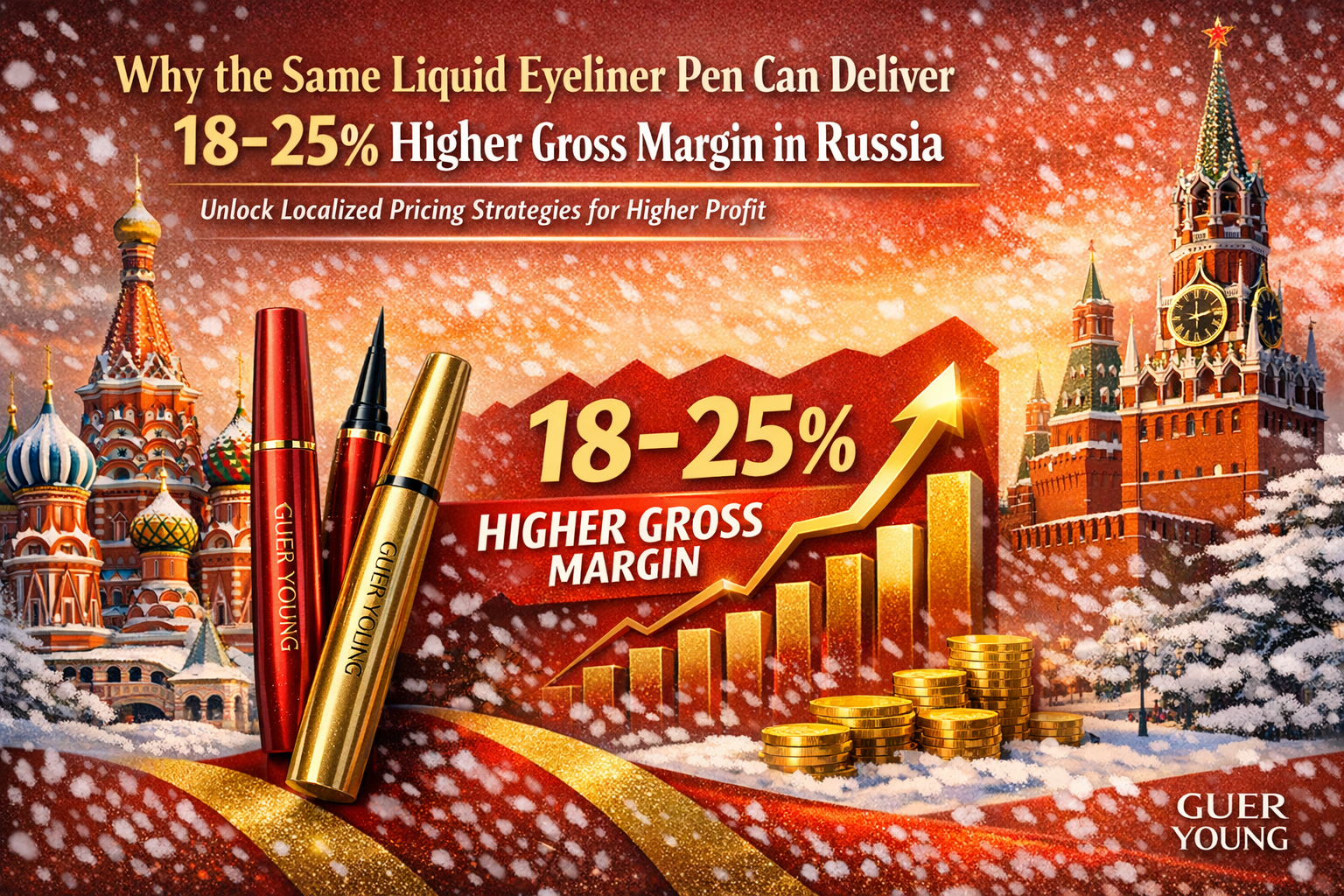
This article explains why the same liquid eyeliner pen can achieve 18–25% higher gross margins in the Russian market. By analyzing channel-based pricing, consumer psychological tiers, and localization strategies, it offers practical guidance for beauty brands, retail buyers, and import distributors entering or scaling in Russia.
Introduction Why the Russian Market Deserves a Fresh Look from Beauty Brands
In recent years, the Russian cosmetics and color cosmetics market has not simply “recovered” — it has entered a phase of structural reshaping and qualitative upgrading.
On one hand, the competitive landscape has shifted, with local brands and new import sources rapidly filling market gaps. On the other hand, consumer behavior has evolved just as quickly:
Growing trust in local or well-localized brands
A move away from purely low-price products toward mid-range and affordable-premium color cosmetics
Stronger focus on functionality, safety, and perceived quality, rather than price alone
Within this environment, one pattern repeatedly appears in real-world projects:
👉 The same liquid eyeliner pen can achieve 18–25% higher gross margins in Russia than in many other markets.
This is not because Russian consumers are willing to overpay — but because pricing logic, market structure, and consumer expectations differ fundamentally.
This article breaks down three localized pricing tier models, supported by practical experience, to explain why liquid eyeliner pens are particularly well-positioned for higher profitability in Russia — and how brands, retail buyers, and import distributors can form faster, more accurate market judgments.
Three Local Pricing Tier Models Behind Higher Margins in Russia
Model 1: Channel-Based Pricing — Online ≠ Offline
In the Russian beauty market, sales channels do more than distribute products — they define pricing ceilings.
Case 1: Online platforms (Wildberries / Ozon)
Online consumers evaluate liquid eyeliner pens based on:
Clearly defined price bands
Core performance claims such as smudge-proof, quick-dry, and long wear
Reviews, ratings, and repurchase signals
In practice, liquid eyeliner pens positioned in a mid-price range with strong functional messaging often outperform ultra-low-priced products — while maintaining healthier margins through scale and cost control.
Case 2: Offline retail (regional beauty chains, drugstores)
Offline consumers place higher value on:
Packaging quality and professional appearance
Brand credibility
Usage scenarios communicated by in-store staff
The same liquid eyeliner pen, with enhanced packaging and localized messaging, can support a higher wholesale and retail price without negatively affecting sell-through.
👉 Key insight:
Russia is not a “one-price-for-all-channels” market. Channels set the pricing ceiling.
Model 2: Psychological Pricing Anchors by Consumer Tier
Russian consumers do not judge liquid eyeliner pen prices purely by income level, but by usage context and self-perception.
Practical example:
Everyday liquid eyeliner pens: stability, safety, all-day wear
Refined or social makeup: color intensity, pen-tip precision, aesthetic finish
By clearly differentiating functional language, visual identity, and naming, brands can create two strong psychological price anchors with minimal cost difference — resulting in 20%+ margin uplift.
👉 The goal is not higher prices, but clearer value segmentation.
Model 3: Localization & Cross-Market Price Differentiation
A common concern among brands entering Russia is:
“Will consumers compare our Russian prices with other markets?”
In reality, when localization is done properly, they rarely do.
Example:
For liquid eyeliner pens tailored to Russia:
Shade tone and line definition adapted to local makeup preferences
Messaging focused on cold-weather durability and long wear
Russian-language packaging with function-first information hierarchy
Even with the same core formula, brands can establish a stable, market-specific pricing system, avoiding global price pressure.
15 Practical Actions to Build Differentiated Profitability
Let channels drive pricing decisions, not cost sheets alone
Control SKU count at market entry
Treat packaging as a pricing tool, not just a cost
Translate functions, not just features
Create different price anchors for different channels
Allow city-level price flexibility
Use product bundles to increase basket value
Avoid globally unified MSRP
Provide distributors with clear and healthy margin structures
Test price elasticity with pilot batches
Turn compliance into trust-building value
Do not use lowest price to secure channels
Define your core consumer precisely
Leave margin space for retail partners
Treat pricing as a strategic decision, not a financial afterthought
Conclusion Capturing the Next Phase of Opportunity in Russia
Higher margins in Russia are not driven by “higher prices”, but by smarter, more localized pricing structures.
The three core pillars are:
Channel-based pricing differentiation
Consumer-tier segmentation
Product and communication localization
In today’s Russian beauty market, localization and differentiation are no longer optional — they are essential profit drivers.
The brands that succeed are not the cheapest ones, but those that understand market structure and consumer psychology.
If you are planning to enter or scale in Russia, one key question deserves careful consideration:
👉 Have you designed a Russia-specific pricing strategy for your liquid eyeliner pen — or are you still relying on a global template?
#liquideyelinerpen#finishedmakeup#makeupoem#makeupodm#beautysupplychain#crossborderecommerce#beautybusiness#beautyimporter#emergingbrands#privatelabelmakeup#beautyb2b#cosmeticswholesale#branddiffere
ntiation#profitstructure#highmarginproducts#beautystartup#dtcbrand#productselection#skustrategy#pricingstrategy#brandpremium#channelstrategy#userexperience#repurchaserate#inventoryturnover#compliancecost#internatio
naltrade#makeupexport#cosmeticsimport#beautyseller#supplychainmanagement#marketpositioning#middleeastbeauty#southeastasiabeauty#europeanmarket#cosmeticsregulation#businesslogic#profitmodel


+86 13825629636
winnie.zhong@gueryoung.com

We have 10 years of experience, focusing on the development and sales of high quality eyelash growth serum, mascara, eyebrow gel, eyebrow color and other products. We also offer custom services, from tube
design to cosmetic fillings and packaging


+86 13825629606

Room 1, C3 Factory Building, No.8803 Zhuhai Avenue, Lianwan Industrial Zone, Pingsha Town, Gaolan Port Economic Zone, Zhuhai, Guangdong,China
PRODUCTS
QUICK LINKS

andy.li@gueryoung.com
lynn.zhou@gueryoung.com
+86 13825629985
+86 13825629619
niki.xu@gueryoung.com